

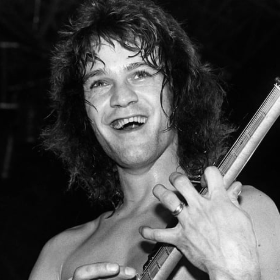
Edward Lodewijk “Eddie” Van Halen was born on January 26, 1955, in Amsterdam, Netherlands. His parents were Jan van Halen, a Dutch big-band musician and clarinet/saxophone player, and Eugenia (née van Beers), a Eurasian (Dutch–Indonesian) woman. Eddie grew up in a musical family alongside his older brother, Alex, who was born in 1953.
In 1962, when Eddie was seven, the Van Halen family emigrated to the United States and settled in Pasadena, California. They arrived with very little money and only a piano. Their father worked odd jobs, including as a dishwasher and janitor, to support the family while continuing to play music on the side. Their mother cleaned houses.
Eddie attended local schools in Pasadena. During his first years in America, he did not speak English, so he and Alex were placed in ESL classes and were sometimes isolated by classmates. Eddie later recalled feeling frightened as a new student and said that other children bullied him. He became friends with non-white classmates who defended him from the bullies. By 1969, he was enrolled at Pasadena High School.
Music remained central to the Van Halen household throughout Eddie’s childhood. Jan and Eugenia had both received classical music training and insisted that Eddie and Alex take piano lessons. The brothers began lessons in the Netherlands and continued them in Los Angeles. Eugenia even “cracked the whip” to make sure they practiced. Eddie proved to be a prodigious piano student and won awards in competitions during his youth.
Eddie and Alex also performed together as children. In elementary school, they formed a band called The Broken Combs, playing at school assemblies and lunchtime recitals. Eddie initially played drums, which he bought with money earned from a newspaper route. After hearing Alex perform a drum solo to the Surfaris’ “Wipe Out,” Eddie switched to electric guitar. As a teenager, he practiced obsessively, sometimes walking around the house with his guitar or locking himself in his room for hours to work on chords and solos.
From a young age, Eddie drew inspiration from the popular music of his time. His early musical taste was shaped by 1960s British pop and rock bands, and he cited groups such as the Dave Clark Five as key influences on his playing. He later became especially interested in U.K. guitarists, learning many solos by Eric Clapton’s band Cream note for note. He also listened to American pop and R&B during this period, though classic rock guitarists remained his lasting influences.
By the end of high school, Eddie’s early music lessons at his mother’s insistence and his experiences in Pasadena’s diverse schools had prepared him for his future, though the details of his career would come later.
| Name | Edward Lodewijk “Eddie” Van Halen |
| Birthday | January 26, 1955 |
| Birthplace | Amsterdam, Netherlands |
| Profession | Musician and songwriter |
| Primary Instrument | Guitar |
| Band | Van Halen |
| Band Founded | 1974 in Pasadena, California |
| Band Roles | Lead guitarist, backing vocalist, and songwriter |
| Debut Album | Van Halen (1978) |
| Signature Technique | Two-handed guitar tapping |
| Notable Album | 1984 |
| Notable Song | “Jump” |
| Music Equipment Brand | EVH |
| Notable Guitar | “Frankenstein” |
| Estimated Net Worth | $100 million at the time of his death; not officially verified |
Formation of Van Halen and the band’s early club years
Eddie Van Halen co-founded Van Halen in Pasadena, California, in 1974 with his brother Alex Van Halen on drums, singer David Lee Roth, and bassist Michael Anthony. The brothers had previously played in local cover bands before forming a group called Mammoth. After recruiting Roth and Anthony, they renamed the quartet Van Halen.
Throughout the mid-1970s, the band performed extensively on the Southern California club circuit, including venues such as Gazzarri’s and the Starwood. Their high-energy shows and Eddie’s innovative guitar work helped build the band’s reputation. In 1976, Gene Simmons of Kiss attended one of their performances and arranged studio demos, which ultimately led Warner Bros. Records to sign Van Halen to a contract. From the band’s inception, Eddie served as lead guitarist, backing vocalist, and one of its chief songwriters, helping shape its hard-rock identity.
Breakthrough with Van Halen’s debut album
After signing with Warner Bros., Eddie Van Halen and Van Halen entered Sunset Sound Studios in mid-1977 to record their debut LP with veteran producer Ted Templeman. Van Halen was released in February 1978 and quickly became a landmark hard rock album.
The album peaked at No. 19 on the U.S. charts (Billboard Top LPs) and eventually sold millions of copies, earning multi-platinum and later Diamond status. It featured signature tracks such as “Runnin’ with the Devil” and a cover of the Kinks’ “You Really Got Me,” while Eddie’s instrumental “Eruption” showcased his then-unique two-handed tapping guitar technique. Critics later wrote that with Van Halen, the band “set the standard for which a new generation of hard-rocking bands would strive.” The breakthrough established Eddie Van Halen’s reputation for extraordinary speed and creativity on guitar and brought the band national prominence.
Redefining rock guitar through tapping and amplification
Eddie Van Halen’s playing style revolutionized rock guitar. He popularized rapid two-handed tapping and other extended techniques that few had used before, expanding what the electric guitar could do.
His sound was shaped by custom equipment, heavily modified amplifiers later formalized in his EVH amp designs, and guitars that produced the distinctive “brown sound” for which he became famous. Rolling Stone magazine ranked Eddie Van Halen #8 on its list of the 100 greatest guitarists. He emphasized musicality over speed, telling Rolling Stone that rock guitar “should have emotion” and that “I just want my guitar playing to make people feel something.” By the mid-1980s, his influence was widespread among rock guitarists, and he was widely acknowledged as a virtuoso whose techniques reshaped the genre.
Eddie Van Halen’s distinctive “Frankenstein” guitar, a heavily modified instrument built to his specifications, became an icon of his sound and later inspired the EVH guitar line.
Keyboard-driven expansion on 1984
Although known primarily as a guitarist, Eddie Van Halen was also a trained pianist and began incorporating keyboards into Van Halen’s music. The band’s fifth studio album, 1984, released in 1984, prominently featured synthesizer-driven songs.
The hit single “Jump” was built around Eddie’s pulsing synthesizer riff, with Eddie playing the keyboard part himself in the studio. 1984 became Van Halen’s most commercially successful album, reaching No. 2 on the Billboard 200 chart behind only Michael Jackson’s Thriller.
The record produced enduring hits including “Jump,” “Panama,” and “Hot for Teacher,” while showing that the band could evolve its sound without losing Eddie’s signature guitar style. 1984 helped knock disco and other trends off the charts through Eddie’s blend of hard-rock riffing and melodic keyboard accents.
Songwriting and recording through the Sammy Hagar era
In 1985-86, Van Halen changed its lineup by recruiting singer Sammy Hagar. Eddie Van Halen remained the group’s lead guitarist and primary songwriter throughout this period, sometimes jokingly called “Van Hagar” by fans. The first album with Hagar, 5150 (1986), became Van Halen’s first No. 1 album on the Billboard 200, confirming the band’s continued commercial power.
Three more No. 1 studio albums followed: OU812 (1988), For Unlawful Carnal Knowledge (1991), and Balance (1995). These records produced several hit singles, including “Why Can’t This Be Love” and “When It’s Love,” combining Eddie’s powerful guitar riffs with a more polished, radio-friendly hard-rock style. During the Hagar era, Eddie integrated keyboards more fully into song arrangements and continued exploring new sounds, while his virtuosic guitar work remained the driving force behind each album.
Launching the EVH guitar and amplifier business
Eddie Van Halen partnered with Fender Musical Instruments in the 2000s to create the EVH brand of musical products, building on his expertise with musical gear. Fender formally launched the EVH line in 2007 with a highly accurate limited-edition replica of Eddie’s famed “Frankenstein” guitar.
Under the EVH name, the company released instruments and amps designed to Eddie’s exacting specifications, including signature Wolfgang guitars in various models and the 5150III amplifier series. These products embodied Van Halen’s tonal innovations, often described as the embodiment of his “sound-crafting abilities,” and made his custom gear available to other musicians. The EVH brand remains known for high-performance guitars and amplifiers that carry forward Eddie’s legacy of tone and playability.
Final Van Halen reunion tours and A Different Kind of Truth
After experiments with other lead singers and a hiatus, David Lee Roth returned to Van Halen in 2007. Eddie, Alex, and Roth were joined by Eddie’s young son Wolfgang Van Halen on bass to complete the lineup. The reunited group toured extensively from 2007 onward, drawing large audiences.
In 2012, Van Halen released A Different Kind of Truth, the band’s first studio album of new material in 14 years. The album featured new songs alongside updated versions of early demos, with Eddie once again anchoring the band’s sound on guitar and occasional keyboards.
The live double album Tokyo Dome Live in Concert (2015) captured performances from these reunion tours. These final projects were Eddie Van Halen’s last recordings with the band, closing a career that spanned from local club beginnings to international rock stardom.
Eddie Van Halen Net Worth
At the time of Eddie Van Halen’s death, his net worth was not officially verified by major financial authorities. His income came from album sales and concert tours, as well as sales of band merchandise, including T-shirts and posters.
He also earned ongoing income through songwriting and publishing royalties, with the Van Halen music catalog managed under a global publishing deal. Specific earnings figures, such as per-tour fees or endorsement payouts, are not publicly disclosed.
FAQs
Was Eddie Van Halen inducted into the Rock and Roll Hall of Fame?
Yes. Van Halen was inducted into the Rock and Roll Hall of Fame in 2007 in recognition of the band’s impact on rock music.
Did Eddie Van Halen play guitar on Michael Jackson’s “Beat It”?
Yes. Eddie Van Halen performed the guitar solo on Michael Jackson’s 1982 hit “Beat It,” one of his best-known recordings outside Van Halen.
Did Van Halen ever win a Grammy Award?
Yes. Van Halen won the Grammy Award for Best Hard Rock Performance with Vocal in 1992 for For Unlawful Carnal Knowledge.
Did Eddie Van Halen own a recording studio?
Yes. Eddie Van Halen built 5150 Studios at his California property, where Van Halen recorded and developed music.
Did Eddie Van Halen hold patents for musical equipment?
Yes. Eddie Van Halen was named as an inventor on U.S. patents related to musical instruments and performance equipment.