

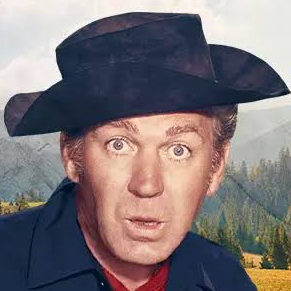
Forrest Meredith Tucker was born in Plainfield, Indiana, on February 12, 1919, to singer Doris Heringlake and minor league baseball player Forrest A. Tucker. After his family relocated, he grew up in Washington, D.C., and excelled at youth sports like golf. At Washington-Lee High School in Arlington, Virginia, he played football and earned varsity letters in three sports. He later attended George Washington University for a time.
Teenage Vaudeville Circuit and Early Comedic Routines
Forrest Meredith Tucker began his performing career as a teenager. At age 14, he worked at the 1933 Chicago World’s Fair, singing at night after finishing his daytime duties.
A year later, he transitioned to professional stage entertainment in Washington, D.C., after winning amateur talent contests on consecutive Saturday nights at the Old Gayety Burlesque Theater. The venue’s owner hired him as master of ceremonies to introduce acts and participate in comic routines.
Film Debut in The Westerner and Initial Studio Contracts
Tucker relocated to California in 1939 and made his screen debut alongside Gary Cooper in The Westerner (1940). Playing Wade Harper, he drew attention for his physical presence and an on-screen fight sequence with Cooper.
The performance led to a 1941 contract with Columbia Pictures, where he worked steadily in feature films. Columbia also loaned him to other studios during this period. He appeared in MGM’s The Yearling (1946) and Warner Bros.’ Never Say Goodbye (1946). Columbia later cast him in Coroner Creek (1948), one of four Westerns he filmed with Randolph Scott.
Action Lead and Western Roles at Republic Pictures
Tucker signed with Republic Pictures in 1948. He initially played villains and tough characters before Republic positioned him as a leading man. His early credits for the studio included Hellfire (1949), The Last Bandit (1949), and Sands of Iwo Jima (1949) opposite John Wayne. Tucker secured his first starring role for Republic in Rock Island Trail (1950), followed by California Passage (1950).
He continued working extensively in Westerns over the ensuing decades, with appearances in Pony Express (1953), Fort Massacre (1958), Gunsmoke in Tucson (1958), and Chisum (1970).
National Stage Touring Success as Professor Harold Hill
In 1958, Tucker joined the national touring production of Meredith Willson’s The Music Man. Taking on Professor Harold Hill the central character originated on Broadway by Robert Preston he performed the role across the country for several years. Reviewers compared his interpretation favorably to Preston’s original portrayal.
The production became one of Tucker’s most substantial stage engagements and established him as a musical-comedy performer. He returned to Broadway in the 1964 production of Fair Game for Lovers.
Network Television Breakthrough in F Troop
In 1965, Tucker joined ABC’s F Troop. Starring as Sgt. Morgan O’Rourke, a scheming yet personable cavalry sergeant, he appeared in all 65 episodes of the comedy series during its run from 1965 to 1967.
Working alongside Ken Berry and Larry Storch, Tucker brought his stage comic timing to the television character. F Troop became his best-known television role and remained in later broadcast circulation.
Saturday Morning Television and Late-Career Comedy Projects
Following F Troop, Tucker worked extensively across television and film. He took character parts in the feature films The Night They Raided Minsky’s (1969), Barquero (1970), Chisum (1970), Welcome Home, Johnny Bristol (1972), and Cancel My Reservation (1972). In 1973, he partnered with Bob Denver for the syndicated situation comedy Dusty’s Trail, which aired for one season.
Tucker subsequently appeared in the short-lived 1976 television series Ghost Chasers and continued working in television in his later years. His late career included the 1975 film The Wild McCullochs and the 1978 television movie A Real American Hero. His career spanned stage entertainment, feature films, Westerns, action productions, musical theater, sitcoms, and television drama.
Forrest Tucker Net Worth
Forrest Tucker’s official net worth at the time of his death was never publicly disclosed or verified by financial authorities. He earned his income through an extensive acting career that spanned film, television, and the stage. Over several decades, he appeared in nearly a hundred motion pictures and numerous television programs, most notably starring in 65 episodes of the series F Troop. While these roles generated his earnings through acting salaries and applicable royalties, no detailed financial breakdown of his estate has ever been released.
FAQs
Q: Did Forrest Tucker serve in the military?
A: Yes. He enlisted in the U.S. Army during World War II and earned a commission as a second lieutenant. He served in the Signal Corps until his discharge in 1945, when he resumed his acting career.
Q: Did Forrest Tucker win any awards for his Western films?
A: Yes. He received the Golden Boot Award in 1983 for his contributions to the Western film genre.
Q: Does Forrest Tucker have a star on the Hollywood Walk of Fame?
A: Yes. He received a star in the Motion Pictures category on August 21, 1986, located at 6385 Hollywood Boulevard.
Q: Did he act in any science fiction or horror movies?
A: Yes. He starred in several British science fiction and horror films in the late 1950s, including The Abominable Snowman (1957) and The Trollenberg Terror (1958).
Q: Who were Forrest Tucker’s immediate family members and heirs?
A: He was married four times and had three children: Pamela, Cindy, and Forrest Sean Tucker.
Q: When did Forrest Tucker die?
A: He died at age 67 on October 25, 1986, at the Motion Picture & Television Country House and Hospital in California.