
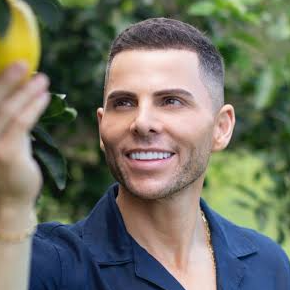
George Thomas “GT” Dave was born in the late 1970s and raised in the affluent Beverly Hills and Bel Air neighborhoods of Los Angeles. The youngest of three sons born to Laraine and Michael Dave, he grew up in a household that embraced Eastern spirituality and holistic health. The family frequently vacationed at ashrams in India and maintained a keen interest in plant-based medicine.
In 1992, while Dave was a freshman at Beverly Hills High School, a family friend gave them a kombucha symbiotic culture of bacteria and yeast (SCOBY)—reputedly sourced from a Buddhist monk. His parents began home-brewing the fermented tea in their dining room. Dave first tasted the beverage at age 13 in his family’s Bel Air home. Though he initially found the taste strange, the experience introduced him to health foods and fermentation.
Dave struggled academically at Beverly Hills High School and left before graduating. He passed his GED around age 16 and subsequently took business courses at Santa Monica College.
In 1994, his mother was diagnosed with breast cancer and underwent surgery and chemotherapy. Following her recovery, Laraine attributed her healing in part to drinking the family’s home-brewed kombucha. Her health crisis and recovery profoundly affected Dave, cementing his family’s commitment to natural foods.
| Category | Key Detail & Fact |
|---|---|
| Name | George Thomas “GT” Dave |
| Birthday | Born in the late 1970s |
| Hometown | Raised in Beverly Hills and Bel Air, Los Angeles, California |
| Early Introduction | First tasted kombucha at age 13 after receiving a SCOBY from a family friend |
| Education Path | Left Beverly Hills High School before graduating and earned his GED at age 16 |
| Catalyst Event | His mother’s 1994 breast cancer diagnosis and recovery cemented his commitment to natural foods |
| First Retail Milestone | Bottled tea in his kitchen and sold his first cases to Erewhon in 1995 |
| Pioneering Scale | First person to place commercial kombucha on U.S. retail shelves |
| Product Innovation | Developed the signature Synergy line in 1997 by blending raw kombucha with fruit juices |
| Market Dominance | Built GT’s Living Foods into the top-selling U.S. kombucha brand, commanding roughly 40 to 47 percent of the market |
| Crisis Management | Reformulated products into the Enlightened line during the 2010 alcohol recall instead of pasteurizing |
| Independent Ownership | Retains 100% private ownership and serves as sole CEO, rejecting multi-million dollar buyout offers from Coca-Cola and Nestlé |
| Portfolio Expansion | Diversified beyond kombucha into raw coconut yogurt (CocoYo), probiotic waters, adaptogenic mushroom teas, and wellness shots |
| Manufacturing Hub | Operates centralized production in a large California facility to preserve raw, unpasteurized fermentation |
| Estimated Net Worth | Unverified exact personal net worth, but anchored by a market-leading enterprise generating approximately $275 million in annual revenue |
Early Home Brewing and Initial Local Retail Distribution
In the mid-1990s, GT Dave (George Thomas Dave) began brewing kombucha in his family kitchen. He started bottling small batches of his homemade tea in 1995, motivated by the health benefits he observed. That year, he sold his first cases to Erewhon, a Los Angeles health food store, making him the first person to place kombucha on U.S. retail shelves.
He gradually expanded distribution across Southern California over the following years. Dave introduced his first flavored kombuchas in 1996, and by 1999, Whole Foods stores throughout the state carried his bottles. He maintained small, authentic batches while growing local demand and refining production.
Pioneering the Commercial Kombucha Category
As founder and CEO of GT’s Living Foods, Dave turned kombucha from a niche home-brewed beverage into a mainstream product. He developed the signature Synergy line in 1997 by blending kombucha with fruit juices and scaled operations through the 2000s. In 2005, he moved production into a larger facility to support national distribution.
GT’s became the top-selling kombucha brand in the U.S., commanding roughly 40 to 47 percent of the market by the early 2020s. Dave managed every aspect of the business, from marketing to quality control. He preserved the raw, unpasteurized fermentation process to maintain the traditional qualities of the beverage. GT’s Living Foods remained an authentic, organic kombucha brand in stores nationwide.
Navigating the 2010 Alcohol Recall and Supply Chain Pivot
In 2010, tests revealed elevated alcohol levels in certain kombucha brands at Whole Foods, triggering a broad recall. Whole Foods temporarily pulled all kombucha from its shelves, and GT’s Living Foods faced class-action lawsuits alleging alcohol content and health claims. Although GT’s products were not the source of the recall, Dave settled the suits, paying a modest combined amount and legal fees.
Rather than pasteurizing the beverage, he spent months tweaking the brewing process to reformulate it. He launched the “Enlightened” line, using a shorter fermentation cycle to lower the alcohol content. The original formula was rebranded as “Classic” and retained as an unpasteurized product. Where legal thresholds permitted, it was sold strictly to adult consumers as an alcoholic kombucha.
Dave regained shelf space while preserving the raw, living qualities of his product. Within a year, Whole Foods and other retailers began restocking GT’s, offering both the new lower-alcohol version and select adult-labeled bottles of the original brew.
Maintaining Independent Ownership Against Corporate Buyouts
Throughout the growth of GT’s Living Foods, Dave rejected acquisition offers from major beverage conglomerates, including reported bids from Coca-Cola, Nestlé, and Unilever. He declined these deals to retain control over the company’s direction and original recipes. Without outside investment, GT’s Living Foods remains family-owned, with Dave serving as sole owner and CEO.
Addresssing these offers, he stated, “I’m not for sale,” noting that surrendering control of his formulas would make him “incredibly unhappy.” Retaining absolute ownership enabled him to navigate the company’s 2010 challenges while protecting his broader vision. As the business entered its third decade, Dave announced plans to elevate internal leaders to manage daily operations, allowing him to step back and focus on product innovation while retaining ultimate strategic oversight.
Expanding the Product Portfolio Beyond Traditional Kombucha
GT’s Living Foods has broadened its portfolio beyond classic kombucha to include a variety of functional beverages and foods. In 2016, the company launched CocoYo, a raw coconut yogurt containing live cultures. The company soon introduced Agua de Kefir, a line of non-dairy probiotic waters, alongside vegetable-based VeggieKefir products.
In 2019, Dave unveiled GT’s ALIVE, an adaptogenic mushroom tea featuring ingredients like reishi, chaga, and turmeric. The expanded lineup also encompasses Immortal, a series of fermented wellness tonic shots, and Dreamcatcher, a line of CBD-infused sparkling waters. All new offerings remain raw, organic, and plant-based.
Today, GT’s Living Foods operates as a multi-product enterprise, with Dave managing research and development to ensure every item—from yogurt to mushroom elixirs—upholds the brand’s commitment to live fermentation and clean ingredients.
GT Dave Net Worth
As of 2026, GT Dave’s exact net worth is not officially verified, though business publications rely on third-party estimates based on his business holdings. He is the founder, CEO, and sole owner of GT’s Living Foods.
The company dominates the market by capturing roughly 40% of U.S. kombucha sales, generating approximately $275 million in annual revenue, and expanding into related product lines like CBD-infused beverages. Because GT’s Living Foods remains fully private and 100% owned by Dave, specific financial details regarding his personal salary, dividends, or exact overall valuation are not open to the public.
FAQs
Q: What philanthropic contribution has GT Dave made to the commercial kombucha industry?
A: In 2019, GT Dave pledged $1 million to Kombucha Brewers International to establish the Laraine Dave Kombucha Education & Lobbying Fund. The fund supports industry lobbying and the creation of formal commercial standards for authentic kombucha.
Q: Where does GT’s Living Foods manufacture its product lines?
A: The company manages all formulation, brewing, and bottling at a campus in Vernon, California, to maintain quality control.
Q: Did any other family health crises shape GT Dave’s business philosophy?
A: Alongside his mother’s recovery from breast cancer, GT Dave lost his older brother, Justin, to bone cancer in 1996. These events shaped his “food is medicine” philosophy and his commitment to using raw, unpasteurized ingredients.
Q: How has GT Dave’s brand intersected with modern internet culture?
A: In 2019, the brand went viral following a reaction video by YouTuber Cody Ko and the “Kombucha Face” meme from TikTok creator Brittany Broski, introducing the beverage to a large demographic of Gen Z consumers.
Q: What charitable initiatives does GT Dave support outside the food and beverage sector?
A: He supports community and youth empowerment initiatives, including Lady Gaga’s Born This Way Foundation. Having faced peer rejection when he came out as gay at age 13, his philanthropy focuses on organizations advocating for mental health and LGBTQ+ acceptance.